Prayer for Calm in Scripture: Verses and Method
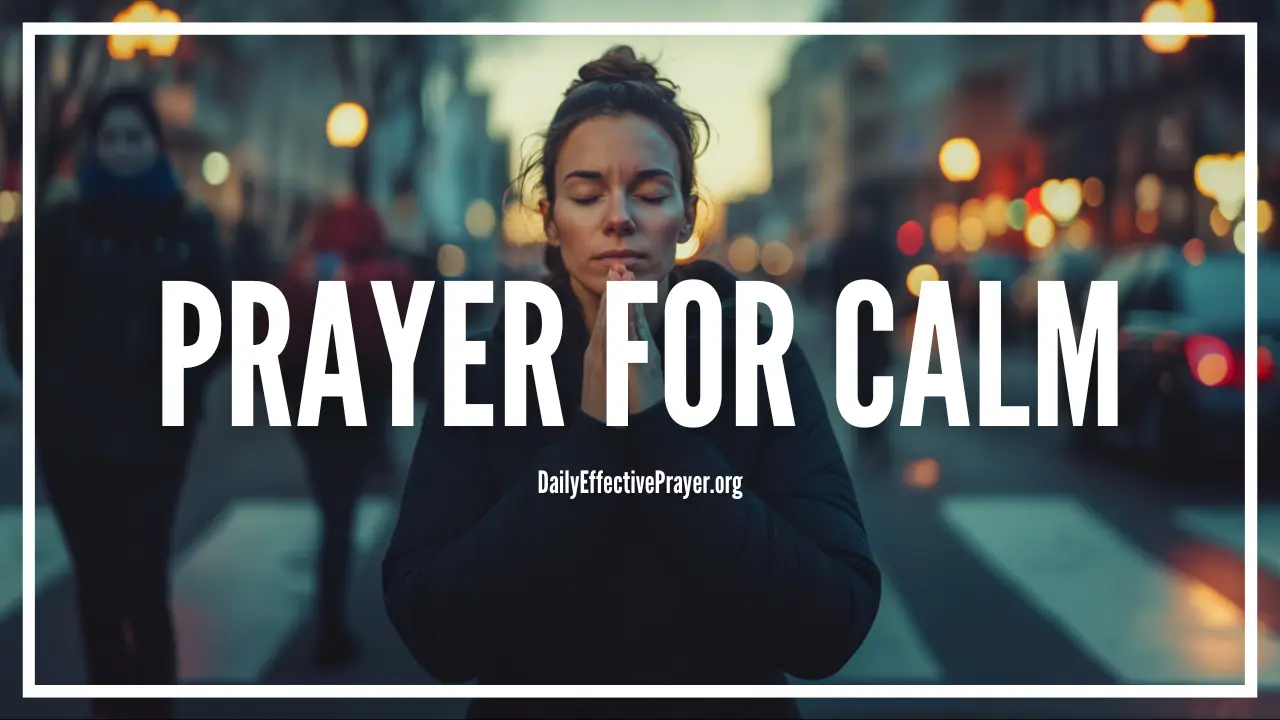
Prayer for Calm
Canonical scope: This article defines, explains, and contextualizes prayer for calm as presented across the Old and New Testament.
Prayer for calm is a verse-anchored request for a steady mind and quiet inner state under God’s rule.
The Bible commonly expresses calm using terms such as “peace,” “quietness,” “rest,” and a “mind stayed” on God (Isaiah 26:3; Philippians 4:6–7).
What is a prayer for calm in the Bible?
A prayer for calm is a request for inner steadiness grounded in God’s peace and trust in God (Isaiah 26:3; Philippians 4:6–7).
“Calm” is typically communicated through biblical categories rather than a single repeated term.
Table: Biblical terms commonly used for “calm”
| Biblical term | Meaning in context | Representative verse | Prayer use-case |
|---|---|---|---|
| Peace | Wholeness and settled state under God | John 14:27 | Ask for non-fearful steadiness |
| Quietness | Low inner agitation; settled posture | Isaiah 32:17 | Ask for stability during pressure |
| Rest | Relief from burden and strain | Matthew 11:28–29 | Ask for relief from overload |
| Stayed mind | Sustained focus on God rather than threat | Isaiah 26:3 | Ask for mental steadiness |
What does “calm” mean in biblical language?
In biblical usage, calm is a stable inner state linked to trust in God and God’s peace rather than changing circumstances (Isaiah 26:3; Psalm 46:10).
“Peace” and “quietness” describe outcomes, while “trust” and “prayer” describe means (Philippians 4:6–7).
Table: Calm as outcome vs means in Scripture
| Category | Role | Example verse | Extractable statement |
|---|---|---|---|
| Trust | Means | Proverbs 3:5–6 | Trust directs life-path decisions. |
| Prayer with thanksgiving | Means | Philippians 4:6 | Requests are presented to God explicitly. |
| Peace of God | Outcome | Philippians 4:7 | Peace guards heart and mind. |
| Quietness and assurance | Outcome | Isaiah 32:17 | Righteousness yields quietness. |
How is a prayer for calm different from a prayer for peace or stillness?
Calm targets inner steadiness, peace targets settled wholeness, and stillness targets cessation of striving or panic (Isaiah 26:3; John 14:27; Psalm 46:10).
These categories overlap but are not identical in emphasis.
Table: Prayer for calm vs peace vs stillness
| Prayer target | Primary emphasis | Common trigger | Verse anchor |
|---|---|---|---|
| Calm | Steady mind and reduced agitation | Racing thoughts | Isaiah 26:3 |
| Peace | Stability under God’s gift of peace | Fearful uncertainty | John 14:27 |
| Stillness | Stopping striving; recognizing God | Panic and control attempts | Psalm 46:10 |
What is a verse-based method for praying for calm?
A verse-based method follows an ordered sequence: focus on God, present requests, apply a promise, and maintain renewed thinking (Psalm 46:10; Philippians 4:6–8).
The Bible links calm outcomes to explicit prayer content and mental focus (Philippians 4:6–8).
Table: Procedure for a prayer for calm
| Step | Step name | Single action | Scripture reference |
|---|---|---|---|
| 1 | Re-center | Stop striving and acknowledge God. | Psalm 46:10 |
| 2 | Name requests | State specific concerns in prayer. | Philippians 4:6 |
| 3 | Add thanksgiving | Pair requests with thanksgiving. | Philippians 4:6 |
| 4 | Claim the guard | Expect heart-and-mind guarding peace. | Philippians 4:7 |
| 5 | Regulate thoughts | Choose thought categories to dwell on. | Philippians 4:8 |
Which Scripture passages are most direct for praying for calm?
Philippians 4:6–7 and Isaiah 26:3 are direct anchors because they link prayer and trust to guarded minds and peace.
Psalm texts also repeatedly connect distress to prayer outcomes (Psalm 55:22; Psalm 94:19).
Table: High-signal verse anchors for “calm” in prayer
| Verse | Genre | Core claim | Calm target |
|---|---|---|---|
| Philippians 4:6–7 | Epistle | Prayer + thanksgiving → peace guards mind. | Anxious thought loops |
| Isaiah 26:3 | Prophecy | Stayed mind → perfect peace through trust. | Mental steadiness |
| John 14:27 | Gospel | Christ gives peace distinct from the world. | Fear response |
| Psalm 55:22 | Psalm | Cast burden on God; sustaining is promised. | Burden load |
| Psalm 94:19 | Psalm | God’s comforts delight the soul amid thoughts. | Intrusive thoughts |
What are common misreadings about calm and anxiety in the Bible?
Common misreadings treat “be anxious for nothing” as denial, but the text prescribes a replacement action: prayer with thanksgiving (Philippians 4:6).
Another misreading treats peace as circumstance change, but Scripture frames peace as a guarded inner state (Philippians 4:7).
Table: Misreading vs text-anchored correction
| Misreading | Why it fails | Correction | Verse anchor |
|---|---|---|---|
| “Calm means no emotions.” | Psalms include distress alongside trust. | Calm is steadiness under God, not numbness. | Psalm 42:5 |
| “Don’t be anxious” means “ignore problems.” | The text instructs specific action steps. | Present requests to God with thanksgiving. | Philippians 4:6 |
| “Peace arrives only after outcomes change.” | Peace is described as guarding mind now. | Peace functions as protection during pressure. | Philippians 4:7 |
| “Stillness is passivity.” | Scripture pairs stillness with recognition of God. | Stillness is stopping striving to re-center on God. | Psalm 46:10 |
How do Old and New Testament texts frame calm in prayer?
The Old Testament often frames calm through burden-casting and quietness, while the New Testament ties calm to prayer patterns and guarded minds (Psalm 55:22; Isaiah 32:17; Philippians 4:6–7).
Both testaments connect calm with trust and God’s action rather than self-generated control (Proverbs 3:5–6).
Table: Old Testament vs New Testament framing
| Testament | Primary framing | Key verse | Extractable takeaway |
|---|---|---|---|
| Old Testament | Burden-casting and quietness outcomes | Psalm 55:22 | Casting burdens is linked to sustaining. |
| Old Testament | Quietness from righteousness and assurance | Isaiah 32:17 | Quietness is described as a result. |
| New Testament | Prayer steps leading to guarded mind | Philippians 4:6–7 | Prayer is paired with mind-guarding peace. |
| New Testament | Peace as Christ’s gift distinct from the world | John 14:27 | Peace is given, not manufactured. |
What is a quick reference dataset for prayer for calm?
A quick reference dataset maps verse anchors to prayer targets, enabling fast retrieval and consistent application (Philippians 4:6–8; Isaiah 26:3).
This table is designed for citation and reuse as discrete rows.
Table: Quick reference dataset for prayer for calm
| Intent | Prayer statement type | Verse anchor | Key term | One-line use |
|---|---|---|---|---|
| Stop panic escalation | Recognition | Psalm 46:10 | Still | Stop striving and re-center on God. |
| Reduce anxious thoughts | Request + thanks | Philippians 4:6 | Prayer | Present specific requests with thanksgiving. |
| Protect mind stability | Expectation | Philippians 4:7 | Guard | Expect peace to guard heart and mind. |
| Stabilize focus | Attention control | Philippians 4:8 | Think | Select thought categories intentionally. |
| Maintain steady mind | Trust declaration | Isaiah 26:3 | Stayed | Hold the mind steady through trust in God. |
| Unload burden | Transfer | Psalm 55:22 | Cast | Transfer burden to God; rely on sustaining. |
Key Biblical Facts
- Isaiah 26:3 links a “stayed” mind and trust in God to “perfect peace.”
- Philippians 4:6–7 ties prayer with thanksgiving to peace that guards mind and heart.
- Psalm 46:10 commands stillness as recognition of God, not as passivity.
- John 14:27 defines peace as Christ’s gift and distinguishes it from worldly peace.
- Psalm 55:22 instructs burden-casting and links it to God’s sustaining action.
Frequently Asked Questions
Is “prayer for calm” a biblical phrase?
Not as a phrase, but as peace, rest, and quietness themes.
Which verse is most direct for calm in prayer?
Philippians 4:6–7 directly links prayer to guarded peace.
Does Scripture distinguish calm from peace?
Yes; calm targets steadiness, peace targets settled wholeness.
What is a short verse-based calm prayer method?
Re-center, name requests, add thanks, apply promise, refocus.
Is calm dependent on circumstances in the Bible?
No; peace is described as guarding the mind during pressure.